
03
Dish 3 of 7 · The law
Are magic mushrooms legal in Thailand? No, and here is the law
Magic mushrooms are a Category 5 narcotic in Thailand, with prison terms for use, sale and import. Plus the Dutch rules for Thai grow kits and spores.
Updated
Magic mushrooms are illegal in Thailand. They are a Category 5 narcotic under the Narcotics Code, and psilocybin is a Category 1 controlled psychotropic substance. Using or possessing them can cost up to one year in prison or a fine of up to 20,000 baht or both, and selling, producing or importing them carries up to fifteen years. In the Netherlands the mushrooms are also illegal, but a Thai grow kit or spores can be bought legally. Checked on 10 October 2026; this page is information, not legal advice.
Overview
| Country | The mushrooms | Grow kit and spores | Source |
|---|---|---|---|
| Thailand | illegal, Category 5 narcotic | producing and importing are offences | Thai FDA |
| Netherlands | illegal, Opium Act List II since 1 December 2008 | kit legal to buy; mushrooms illegal once they appear | Opium Act, Trimbos |
| United Kingdom | illegal, Class A, fresh or prepared, since 18 July 2005 | producing mushrooms is an offence | Drugs Act 2005, s. 21 |
| United States | illegal under federal law, Schedule I | spores without psilocybin not federally controlled; states differ | 21 CFR 1308.11 |
Thailand: the Narcotics Code
Thailand rewrote its drug laws in 2021. The Narcotics Code B.E. 2564 was published in the Royal Gazette on 8 November 2021 and came into force in December 2021, replacing the Narcotics Act of 1979 and several related acts (Baker McKenzie). The Code keeps the familiar five categories of narcotics. Magic mushrooms sit in Category 5; the Thai FDA describes them as a narcotic plant. According to the 1990s fieldwork of John W. Allen, the mushrooms were first banned in 1989 (Allen et al.).
The Thai Food and Drug Administration, part of the Ministry of Public Health, set out the penalties in a public warning in December 2024 (Thai FDA):
| Offence | Prison | Fine |
|---|---|---|
| using or possessing | up to 1 year | up to 20,000 baht, or both |
| producing, importing, exporting, selling or possessing without permission | up to 5 years | up to 500,000 baht |
| the same with commercial intent or distribution to the public | 1 to 15 years | 100,000 to 1,500,000 baht |
The same warning states that psilocybin itself is a Category 1 controlled psychotropic substance under Thai law, and links the announcement to the death of a British tourist in Chiang Mai province, described on the Thailand page.
The 2024 notification changes nothing for visitors
In April 2024 a ministerial notification opened a narrow route for psilocybin products within licensed, approved research and clinical programmes. It does not allow personal use, sale to the public or import, and it does not apply to anyone outside such a programme (Tilleke & Gibbins, June 2024). Headlines about Thailand "opening up" to psilocybin refer to this, and they are easy to misread.
Shakes, menus and what open sale means
Mushroom shakes on Koh Phangan and omelettes on Koh Samui have been sold for decades, often openly. Open sale is a matter of enforcement, and enforcement can change overnight: the 2018 raid on a Koh Phangan beach bar and the 2024 arrests in Chiang Mai both followed years of visible trade. A foreign passport does not protect a buyer. Bringing spores, kits or mushrooms into Thailand from abroad counts as import.
The Netherlands: kit legal, mushrooms not
Since 1 December 2008 mushrooms that naturally contain psilocin or psilocybin are on List II of the Opium Act, and the list names Psilocybe cubensis. Thai is a cubensis cultivar, so it is covered (Opium Act).
The grow kit is treated differently. The Trimbos Institute writes that containers for growing psychedelic mushrooms can still be bought legally in the Netherlands, and that the mushrooms become illegal as soon as they appear above the surface (Trimbos, drugsinfo.nl). The Public Prosecution Service defines up to 5 grams of fresh or 0.5 grams of dried mushrooms as a user quantity and in principle does not prosecute possession up to that amount (OM guideline). A prosecution guideline is not permission.
Spores are a separate case. A laboratory study found no psilocybin or related tryptamines in cubensis spores (Gotvaldová et al., 2021), and spores are not on the Opium Act lists. The Thai spore syringes and vials sold in Dutch shops are legal to buy there.
Taking part in traffic after use is prohibited, as the Jellinek addiction care organisation points out (Jellinek).
The United Kingdom and the United States
In the UK, any fungus containing psilocin or an ester of psilocin has been a Class A drug since 18 July 2005, whatever form it is in. In the US, psilocybin and psilocyn are Schedule I under federal law; spores without psilocybin are not federally controlled, while some states, such as California, prohibit cultivation with intent to produce. State programmes such as Oregon's licensed service centres do not allow home cultivation.
Ordering from the Netherlands
Dutch shops ship grow kits and spores abroad, but the law that applies is the law where the parcel arrives and where the kit would be grown, including the rules on import. A product that is legal to sell in the Netherlands does not become legal in Thailand, the UK or Germany by being shipped from there. This site does not recommend ordering, importing or growing anywhere it is against the law. The Thai products below are for buyers in the Netherlands, aged 18 or over.
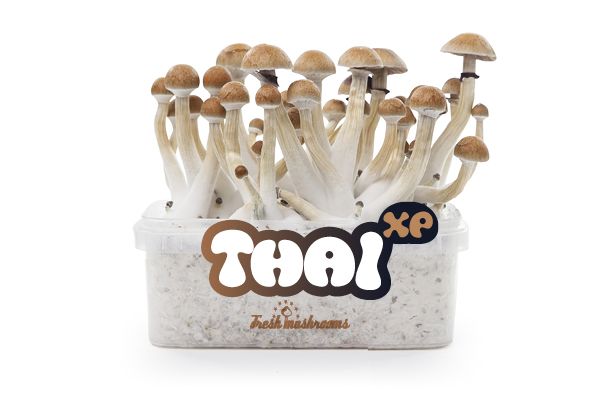 Thai - FreshMushrooms Magic Mushroom Grow Kit
Dutch-Smart
€39.50Order
Thai - FreshMushrooms Magic Mushroom Grow Kit
Dutch-Smart
€39.50Order
 Thai - Spray 20 mL
Dutch-Smart
€14.90Order
Thai - Spray 20 mL
Dutch-Smart
€14.90Order
More: which Thai kit to choose, the measured strength and effects and safety.